


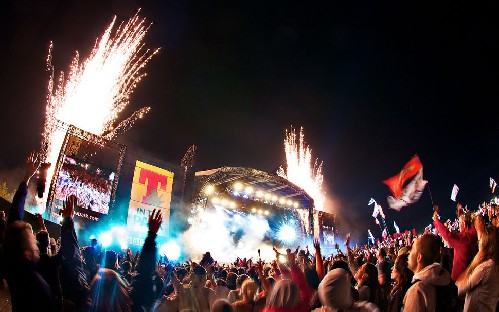
Back in June, (here), we reported that an economic study had suggested that more than 1 in 10 festivals will fold this year amid ever-increasing security and infrastructure costs and tough competition for ticket sales.
eFestivals said that it believed that was very unlikely to happen, yet having crunched the numbers for this year we can see that our festival listings have reduced by 172 UK events in 2016 to 898, from 1070 in 2015. A figure which is nearly 3 times any previous figures in recent history. eFestivals at the time predicted the number of festivals going on 'hiatus' would be around 60, and we haven't factored in the 28 events which cancelled after intending to run and getting a listing (making 200 in total).
The figures would suggest that economically the festival 'bubble' has burst again, the first time was in 2007 (the year incidentally that Glastonbury Festival struggled to sell tickets). It was at this time that the festival market first went past saturation point, and cancellations were in proportional terms higher than any year since.
The recent cancellation of BSTK is a case in point, after 12 years organisers made the difficult decision to shut the farm gates citing changes in the industry, their promotion company Count of Ten, had a few weeks before sold its other festivals Y Not and Truck to the Global group.
Perhaps the festival industry runs in roughly 10 year cycles, and it looks as though many events hit the buffers around their 10th anniversary, when their organisers feel it's time for them to take a break.
Whilst the situation is not dire, and still exceeds the number of events listed in 2010, eFestivals has been looking at next year and is already aware that 60 of just the events it usually reviews (over the last few years) will not be on the calendar in 2017.
The good news is that most of the events decided not to run rather than be forced to cancel, with this year registering the lowest percentage of events cancelling that were intending to go ahead.
% of festival listings cancelled on eFestivals by year.
number cancelled in 2016: 28 of 898 = 3.12%
number cancelled in 2015: 47 of 1070 = 4.39%
number cancelled in 2014: 35 of 1010 = 3.46%
number cancelled in 2013: 36 of 960 = 3.75%
number cancelled in 2012: 57 of 929 = 6.13%
number cancelled in 2011: 40 of 934 = 4.28%
number cancelled in 2010: 36 of 801 = 4.49%
number cancelled in 2009: 41 of 710 = 5.77%
number cancelled in 2008: 43 of 633 = 6.79%
number cancelled in 2007: 31 of 496 = 6.25%
The festival industry in the UK saw a massive growth from 2000 to 2011. Since then for the last five years there's been around 1,000 festivals a year, indoor and outdoor events which are mainly live music big and small, now it would appear a return to the numbers of 2010.
eFestivals data would suggest that since 2013 the UK has hosted around 1,000 festivals and outdoor music events a year, and it looks as though this year will have around 900 and a conservative estimate of around 850 next year. The industry is clearly experiencing a contraction, and this is nearly twice as many as 12 years ago, and much less than the peak in 2014/15, the year before extensive Arts Council England's funding cuts resulted in the closing of many community festivals.
eFestivals has for some years now reported that the number of music festivals each year has remained fairly constant, at saturation point, with the number of new events replacing those falling by the wayside being fairly equal in number. However it would seem economic factors are reducing that number. This number could well decrease further with the onset of Brexit, as events now employ a lot of European workers with experience in stewarding, infrastructure, and for the more menial tasks - things like keeping their toilets cleaning, as well as performers and entertainers. Plus nearly half a million of the 3.7 million UK festival goers come from overseas. Tougher border controls could put a dent in these numbers.
A bad summer of poor weather is likely to put more events to the sword, as will any further downtown in the economic fortunes of those who make up a festival's audience. It's nothing new that some UK festivals do suffer in a costly and crowded field, they have done for many years now, and pay the price if they don't get it right.
Just as in 2010 it's also clear that a few of the major players are also starting to control more of the market, by continuing to acquire festivals and entertainment companies. For example Festival Republic looking to buy into Metropolis, and Live Nation's continued expansion with the recent acquisition of the Sweden Rock Festival, and now have the largest festival portfolio in the world.
The landscape of festivals has been changing over the years, with new events rising in popularity and some of the more established events waning, and eFestivals has tried it's best to reflect that festival landscape as it alters. It will be interesting to see if any major empires topple next year and who will emerge to take over.