


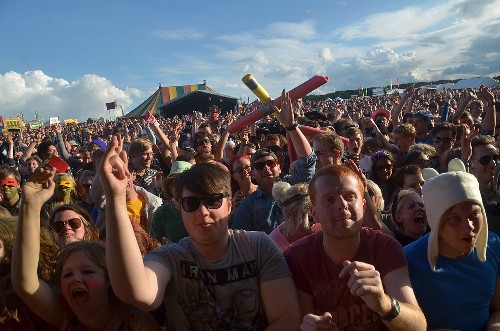
A report published today shows that the British music industry is continuing year on year to contribute more to the UK economy generating £4.1bn in 2014. The first time it has crossed the £4 billion mark (it was £3.8b in 2013), with live music revenue contributing a quarter of that according to figures published by trade body UK Music (here). The report does not distinguish music festivals from the live music market as a whole.
The music industry market grew by 5%, which is faster than the British economy as whole, which grew at around half that pace (2.6%) in the same period.
Whilst money from recorded music continues to fall, Britain is the second-largest provider of recorded music in the world, accounting for 13.7% of global sales, there's a continued increase in revenue from live music sales, which jumped 17% to £924m.
The report also reveals that 117,000 people are employed by the British music industry, it added, of which 69,300 were professional musicians.
The Live music sector has the fastest GVA (gross value added - the contribution to the economy of each individual producer) and employment growth in 2014, employing 25,100 people, as a result of almost 26.7 million visits being made to live music events in the UK in 2014.
Although the obvious response is to say that this increase in revenue is due to increasing ticket prices, however we'd like to note that the number of early bird offers and frozen prices means that for most festivals we listed in 2014 tickets were available to fans at lower or the same price as last year. Suggesting that these figures mean there's more people going or the same people going more often to live events in 2014 compared to 2013.
Please note this does not take into account the pricing structures of indoor live music events.
The festival industry is seeing a small period of growth again with 1010 events listed by eFestivals in the UK for 2014, compared to 960 in 2013, and we have listed 1070 events for this year (2015).
The festival industry in the UK saw a massive growth from 2000 to 2011. For the last few years there's been around 1,000 festivals a year, indoor and outdoor events which are mainly live music big and small. Going back a few years there were only ATP, and the Northern Soul type events out of season, now growth in the last two years has been mainly in the out of season indoor winter festivals.
However in the summer season there's signs this year that there's been too much expansion again, just as there was in 2012. Since the Olympic year when many events cancelled, the number of planned festivals not going ahead has been falling year on year, however this year the trend has reversed, and there's been an increase in the number of festivals cancelled, as the date below shows.
% of festival listings cancelled on eFestivals by year.
number cancelled in 2015: 47 of 1070 = 4.39%
number cancelled in 2014: 35 of 1010 = 3.46%
number cancelled in 2013: 36 of 960 = 3.75%
number cancelled in 2012: 57 of 929 = 6.13%
number cancelled in 2011: 40 of 934 = 4.28%
number cancelled in 2010: 36 of 801 = 4.49%
number cancelled in 2009: 41 of 710 = 5.77%
number cancelled in 2008: 43 of 633 = 6.79%
number cancelled in 2007: 31 of 496 = 6.25%
Of course, this doesn't take into account trends in what people want from a festival, or the number of festival goers attending festivals, and we could perhaps be seeing that festival numbers peak in four year cycles, as the previous peak years for cancelled events were 2008, and 2012.
The results do not show that amongst those festivals which have cancelled capacity changes. So if there's a large scale, high capacity event cancelled and that's been replaced by a smaller scale event, or conversely a large scale event may have launched with a small scale event cancelling. However in our experience this pans out, and there's a certain stability in the industry, with around 1000 or so events happening each year since 2011 (our figures are down some years as although events were happening we were unaware of them and so hadn't got them listed).
Our figure also suggest that the maximum total number of tickets on sale each year has been static for the last few years at around the 6-6.5 million mark.
If every ticket was sold for the events we knew the daily capacities for then the total number of people attending a festival for a single day at peak for the last few years would have been:
maximum daily known capacities attending a festival for a single day at peak in a year
2015: 651 festivals, and 6,267,743 attendees
2014: 655 festivals, and 6,192,292 attendees
2013: 663 festivals, and 6,074,944 attendees
2012: 627 festivals, and 6,455,701 attendees
We do already have 350 events listed for 2016, which is a healthy situation for this time of year, with many more set to join them before now and next summer.
To see what's available see our festival search page.