2009 saw the cinema move to a new corner of the Festival. Now located at the bottom of the Acoustic field, near to a bar, in Michael's Meadow, and moved from an outdoor field with a screen to indoor a large marquee.
The new location is close to the Kidz field for children to watch morning matinees. The Festival does recommend that kids coming to see the movies are accompanied by an adult. The cinema also offers some 3D movies, has the occasional personal appearances, lectures, and even a few Q&A sessions.
Previously to 2009, the cinema field was near Woodsies, close to the John Peel stage on the west side of the site. The cinema is run by Michael Denner who explains the history of the cinema at Glastonbury Festival below:
written
by Michael Denner
May 1999
|
How
it started By 1983 the size of the tent had grown to a proper marquee but the projection system remained more or less the same. The only difference being a bigger sound system, small by to days standards but adequate. |

| 1984 was the year of the miners strike and believe it or not we had miners at the festival, they made them selves a nuisance by climbing onto the roof of the tent and sliding down. |

| 1985 saw the first major technical advance. The step from 16mm to 35mm. The projector was an old Westar 2001 on a western electric soundhead, it probably dates from the late thirties. |

| 1989 saw the introduction of the open air screen as the cinema tent's popularity had now out grown even the largest of marquees, the screen was a mere 32 feet wide. Also the cinema moved to the area where Muddy Lane crosses what was then the main stage road, and was to became a famous landmark and meeting point for people at the festival for many years to come. |

| This also was a perfect spot for cinema as the natural slope of the hill provided an ideal rake allowing the best possible viewing area for the audience, also the picture could be seen right to the top of the camping area called Big Ground. This patch didn't come with out its own special set of problems though, mainly from the camping which bordered the cinema area. It was highly desirable to be able to relax in your tent by your camp fire and watch the latest movies. Or simply drift off to sleep listing to the ambient sounds playing through the sound system after the films had finished for the night. We used to have to post a 24 hour guard of field stewards to in the cinema area to stop campers pitching right in front of the screen. |

| 1990 saw the introduction of Dolby Stereo to the open air cinema at Glastonbury for the first time. This proved extremely popular, because in the open air the stereo effects coming from surround speakers are far more noticeable due to the total lack of reverberation normally found in cinemas. |

| In
92 it was felt that there was a big enough demand for arts and special
interest films that was not being met. Which normally only get seen
in regional film theatres. This meant the reintroduction of the
film marquee. These films were chosen and the tent staffed by the
Edinburgh Film Guild.
Things ran with out any major changes until 94, when just two
weeks before the festival the pyramid stage caught fire, needless
to say it was a major blow to the festival because as well as
being the main stage it also served as a store. A large amount
of festival equipment including the outside cinema screen was
lost in the fire. This meant we had our work cut out making a
new screen in time, but in a way it was also a blessing in disguise
as it gave us the opportunity to make the new screen bigger, lighter
and easier to handle than the previous one. The replacement now
For the 97 festival it was felt that due to the congestion caused by the cinema in the market area over previous years, the cinema should be found a new home. The problems were caused mainly by the huge numbers of people entering and leaving the cinema area when the films changed. So it was decided that the cinema should be given it's own field, which meant the film marquee and the open air screen could once again be together for the first time in nearly five years. This also had the affect of opening up the festival site in general, and making better use of previously under used fields towards the western side of the site. Unfortunately that year it rained heavily just prior to the festival and hole site turned into a mud bath. The outdoor cinema still proved hugely popular despite the rain, and due to the greater space available we probably had our biggest crowds ever, somwhere in the order of 6000-7000 people for with the least amount of hassle. Also in 98 the World cup video screen was in the cinema field. |
 measured 56 feet wide by 24 feet high, at the time it was the
biggest 35mm cinema screen in the country. Also new for 94 was
the first use of Dolby Digital at Glastonbury. Which is now the
standard, digital cinema sound system used in cinemas through
out the world. In order to play the digital tracks properly the
PA system had to be up-rated to handle the higher peek levels
and improved frequency response. So we got in a 35Kw JBL sound
system. 1995 was basically the same with the addition of a laser
show between the films.
measured 56 feet wide by 24 feet high, at the time it was the
biggest 35mm cinema screen in the country. Also new for 94 was
the first use of Dolby Digital at Glastonbury. Which is now the
standard, digital cinema sound system used in cinemas through
out the world. In order to play the digital tracks properly the
PA system had to be up-rated to handle the higher peek levels
and improved frequency response. So we got in a 35Kw JBL sound
system. 1995 was basically the same with the addition of a laser
show between the films.

| Preparation Generally work starts on the Glastonbury cinema area in early January with a meeting with Michael Eavis to work out the budget, and any other logistical problems that were raised the previous year. Nothing much happens after that until March. Though I keep a continuos close eye on what films are doing well in the cinemas that would make good festival films. From April I start getting the projection equipment out of moth-balls and assemble everything in my workshop and get it running. I probably run the equivalent of several feature films during the testing stages to ensure there are no problems with the equipment.
The projector I use now is the one I have used since 1986. |
 It
is a Ross GC3 projector head, which sits on an RCA 9031 sound-head.
The projector head probably dates from around 1945. The only reason
I use this particular model of projector is that it is relatively
small, light and modular and readily lends its self to portable
operation. The projector is mounted on a custom built stand. Which
also contains a long play tower system, all designed by myself.
This enables all the reels of film. usually 6-7 reels to be joined
together on one large spool, doing away with the need for a change
over every twenty minutes, as was the practice in the old days.
The light is provided by a 7000 watt Xenon lamp. I also have two
10,000 water cooled lamps, which I have not used yet. Though this
years festival may be the first time it depends on how much spare
time I have. The screen this year is going to be a massive 64
feet wide and the distance from projector to screen will be 260
feet. This will once again make it the biggest 35mm cinema screen
in the country except for the Imax screens, but these are not
proper cinemas they don't count.
It
is a Ross GC3 projector head, which sits on an RCA 9031 sound-head.
The projector head probably dates from around 1945. The only reason
I use this particular model of projector is that it is relatively
small, light and modular and readily lends its self to portable
operation. The projector is mounted on a custom built stand. Which
also contains a long play tower system, all designed by myself.
This enables all the reels of film. usually 6-7 reels to be joined
together on one large spool, doing away with the need for a change
over every twenty minutes, as was the practice in the old days.
The light is provided by a 7000 watt Xenon lamp. I also have two
10,000 water cooled lamps, which I have not used yet. Though this
years festival may be the first time it depends on how much spare
time I have. The screen this year is going to be a massive 64
feet wide and the distance from projector to screen will be 260
feet. This will once again make it the biggest 35mm cinema screen
in the country except for the Imax screens, but these are not
proper cinemas they don't count.Latest Updates
 Glastonbury Festival 2024
festival details
 Glastonbury Festival 2024
line-ups & rumours
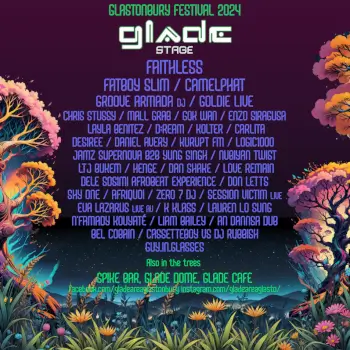
 Glastonbury 2024 - The Glade Posters Reveal Huge Lineup
Faithless, Fatboy Slim, and Groove Armada confirmed
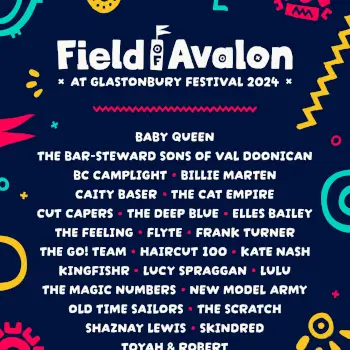
 Glastonbury 2024 - Field Of Avalon Reveals Lineup
Baby Queen, BC Camplight, The Feeling to take to the Avalon Stage
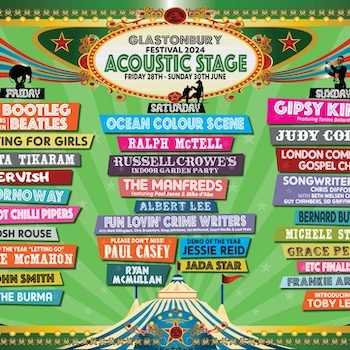
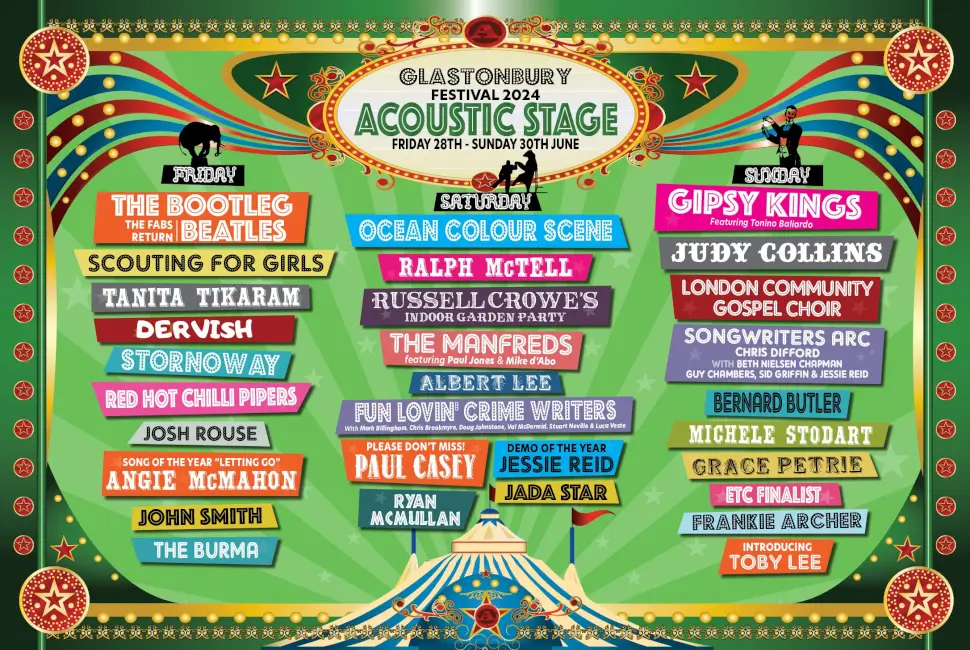 Glastonbury 2024 - First Acoustic Stage Acts Announced!
The Bootleg Beatles, Scouting For Girls, and Ocean Colour Scene set to perform